By Killian · 25 July 2026
A beautiful website, these days, proves nothing. It's the bare minimum, something anyone can put together over a weekend with three templates and two prompts. And yet I keep seeing organisations that look gorgeous online and don't move an inch. Of course: a shop window doesn't save a shop that isn't running right behind it.
A beautiful website won't fix a problem that sits deeper
An example, anonymous. An organisation with a very well-built website. Lots of sections, too many sections, but handsome ones, with real style, a real identity. Every standard respected, the call-to-action buttons exactly where they belong. Clean, corporate, beyond reproach. This brand did many very different things, and had even made that many-sidedness its image. And to be clear: it could have worked. Doing a lot of things is entirely possible. The real problem wasn't the quantity. It was that the poles contradicted and repelled each other. Like two identical poles of a magnet: you can push them together all you like, they refuse to stick. Visitors arrived, hit a wall of offers with nothing to do with one another, and left.
Here's an image for it. And believe it or not, it came from a six-year-old. You drive a certain make of car, and you can choose between two garages of comparable price and quality: one specialises in your make, the other does everything. You'll go to the specialist without thinking. Nobody buys flowers at the bakery. And when a shopfront announces itself as bakery, hairdresser and patisserie all at once, or a restaurant lists Savoyard fondue, sushi, couscous, pad thai and pizza on the same menu, your brain decides for you: it cooks everything, so it's good at nothing.
The worst part is that this brand was probably excellent at every one of its trades. But by stacking them, it sabotaged its own credibility all by itself. No new set of mockups would have repaired that. The real remedy wasn't on the website: it was to segment. And not just tidy tabs in a menu. Segment at brand level: distinct brands for distinct worlds, each on its own market, each asserting one clear strength. The website was only the symptom. The problem sat upstream.
A website is one brick. The ecosystem is the house.
Let's talk about the ecosystem, since the word is fashionable and nobody ever bothers to define it. To me it's simply the set of tools that carry your communication. Not just the website: social media, the Google listing, a newsletter if you need one, the blog. Print too, which gets forgotten far too quickly: business cards, flyers, physical materials. Sometimes internal tools as well, including how you use AI inside the organisation. That's the visible part.
But there's a part nobody sees, and it's almost always the decisive one: operations. Before you communicate, the experience your clients actually live through has to hold up. Communicating about a disappointing product, a wobbly process, a chaotic organisation, is plugging a megaphone into the problem. Honestly, I'd almost drop the word "digital", because what's jammed is usually very concrete: an average product, a sign-up form that scares people off, a labyrinth of a price list nobody finds their way out of.
One detail says it all: having to ring a client to find out what they ordered, or whether they paid. It sounds trivial. In truth it screams "we're improvising". Conversely, when everything is tracked, clear, fluid, the client feels it without knowing why. They simply think: these people are serious.
Nobody sees your backstage. Everybody feels it.
The real work is usually invisible
A concrete case, anonymous again. An organisation whose offer was excellent, but unreadable. Signing up was an obstacle course, and nobody internally had a clear view of what was happening. To the point of having to ring clients back to reconstruct what they'd taken. People stayed, because the product was worth it. But everything around it manufactured frustration and drop-offs: people ready to pay who gave up, lacking the energy to clear the hurdles. Growth had quite simply outrun the capacity to organise.
We could have handed them a magnificent website. It would have changed nothing. As long as the substance wasn't sorted, every euro of communication was a euro out of the window. So we started with the grease: management tools to see clearly, client-side tools to reach the offer without giving up, funnels reworked several times, sometimes live. The offer was complex, and it had to stay that way: its complexity was its richness. The job was to make it simple to live with, not simplistic.
Once the substance was sound, only then could we build, launch, communicate. And the perception flipped. Here's the key point: your regulars already know you, they're convinced, and they're the first to be delighted when the experience improves. But they aren't what's at stake. What's at stake is the newcomer, the one you absolutely mustn't discourage. Sending a brand-new prospect to an organisation that limps isn't "getting ahead". It's postponing the problem, burning money, and condemning yourself to start over. Without treating the substance, there's no chance.
Several people involved, no problem. No coordination, disaster.
We tend to think the problem is having too many providers. Wrong. The designer, the developer, the person on social can be several people, no problem at all. The real problem is coordination: everyone knowing which end their work serves. Each can apply best practice in their own corner; with no coherence between the bricks, it's a house without mortar. It stands for a while. Then it collapses, usually at the worst possible moment.
Take social media. The right answer isn't an army of contributors, it's one community manager. One. You can feed them through a transmission channel, a pipe where information and raw material travel up to them, but they're the one who selects, coordinates and writes the posts, in a voice already worked out beforehand (AI can assist, provided the tone is defined). Otherwise it's a mess: four people posting in four styles on the same day, publications cannibalising each other. You need a line and a plan. Not necessarily carved out six months ahead, but a shared direction, held by a single hand.
And above all, that plan has to be able to move. This is where the classic model breaks its teeth: the frozen specification, where the slightest change triggers an amendment. Except a living project changes constantly. The deeper you understand an organisation, the more you discover that things settled at the very start need changing, even when everything is already live. You have to be able to throw out what was planned and add what wasn't. An overall vision, flexible, agile. Success isn't a deliverable you tick off. It's a continuity.
Before rebuilding everything: think
If you have a beautiful website and it isn't taking off, the first thing to admit is that the culprit may not be the website. Having a beautiful website is easy. Having a website that converts is another trade entirely. And converting can't be guessed: it's tested, it fails, it gets adjusted. You only see results by trying, again and again.
Watch out for that word "convert", by the way: it doesn't necessarily mean selling within the second. It also means establishing your brand, letting an image sink in. But a true image. People are stuffed with generic, with "we're here for you", with "at the service of your ambitions", that mush any competitor could copy and paste without lying, and without anyone noticing the switch. The only question that counts: what does someone find with you that they'll find nowhere else?
Next, the competition: map the market, spot the ground nobody occupies, and resist the temptation to copy. If you look like the others, you disappear along with them. Next, positioning, the heart of the reactor: who you are, who you aren't, the little something extra. Often one clear sentence does more work than a corporate paragraph. Only then, your voice: the tone, the words, the images, what you tell to ring true. And once all that is settled, we talk about tools. Not before.
Starting with the website, without that work, is money thrown away. You'll start over, start over, start over, until you're sick of it. Better to invest first in vision and positioning: everything can move afterwards, but the foundations will hold. Without strategy you navigate blind. You're on a boat adrift, pushed by the currents, never rowing towards a heading.
Communication shows your difference. It doesn't create it.
This is perhaps the most misunderstood point in the whole trade, so let me be blunt.
Communication doesn't create your difference. It only shows it.
Your difference is born in the real world, in what you actually do, in the experience your clients live. Communication is in service of that, and that alone. If the real world doesn't hold up, the finest communication on earth only displays the emptiness in large format.
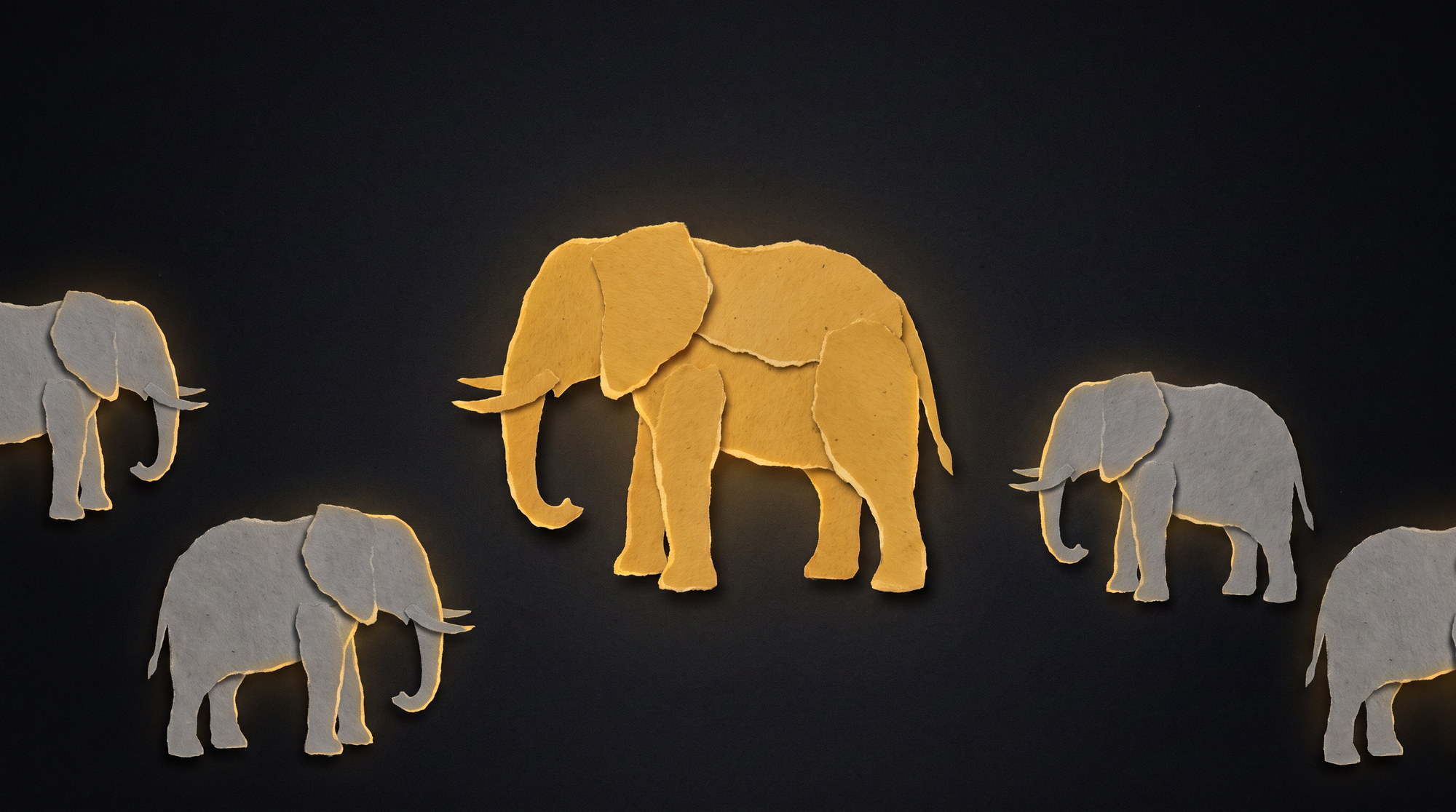
And here comes a reversal I repeat until my voice gives out. The thing that bothers you, that little detail you believe is negative and keep sanding down to "look professional", is very often your greatest strength. Your singularities aren't flaws to hide. They're your best assets. Your real clients stay with you precisely because of them, because of the rough edges you spend your time filing away. In trying to look like everyone else, everyone ends up alike, and nobody exists any more. That's the grey herd, fed on the same jargon and the same templates. The biggest obstacle to clear is the urge to fit your sector's mould. Dare the truth. It's the only way out.
Being visible isn't enough
Visibility gets sold to you as the holy grail. It's necessary, online as in real life. But it's only the front door. Once you've been found, if the only way to reach you is a discouraging form, you lose people on the doormat. And if what you show is vague, generic, or less convincing than the site next door, you're the one who gets forgotten, without a second thought.
Here's the real danger: someone turns up at your place and meets somebody else. Somebody you aren't. For those who already know you, it's confusion. For newcomers, it's disappointment the day they meet you in person and don't find the promise. That's why it all holds together: visibility, conversion, follow-up, experience. A web where every thread holds up the others. One thread goes slack, and the whole web sags. That's exactly why an ecosystem thought out as one piece, with a central logic, crushes a pile of parts that ignore each other.
And never forget the physical world. The communication that works best is still the one made of real encounters: events, trade fairs, people in the flesh. The website isn't the source of all that, it's the rallying point, the window that reflects you twenty-four hours a day. On one condition, always the same one: that it be true.
And AI? It'll give you a beautiful website. A generic one.
One last word, because the temptation is enormous. Yes, today you can have AI build you a beautiful website with a snap of the fingers. And that's precisely the trap. AI manufactures generic. It takes an average of everything that already exists and serves it back to you, nicely tidied. At no point will it have the idea that belongs to you alone, because it has no foothold in your reality. Leaning on it entirely is booking your own place in the grey herd.
Use it, obviously. To speed things up, rough them out, correct them, it's a formidable time-saver. But be very careful about what you hand over. Who you are, what you do, what makes you unique, none of that can be guessed: it's lived, and it's yours to decide. AI is a magnificent grey machine. The colours are what you bring.
In the end it all comes back to the same place. A website isn't a strategy. It's the reflection of a truth built elsewhere: in your offer, your organisation, your singularity owned. Sort that first. The rest is scenery. And scenery has never paid the bills.