By Killian · 27 July 2026
The day price is your only argument, you've already lost. You've entered the one war nobody wins, the cheapest-wins war, where you only hold on by shaving margins, until you're interchangeable, then invisible. And nobody falls into that war by choice. You slide into it, very gently, by looking like everyone else.
Mind you, price isn't always the enemy, and it doesn't say the same thing to everyone. It depends what each person expects. Take food: one person will happily pay far more for a quality that meets their standards, while another decides that for the same use, cheap does the job perfectly. Two customers, two readings of value, and neither is wrong. There are even worlds where too low a price worries people, where it casts doubt on quality instead of reassuring. So the real question is never being the cheapest in absolute terms. It's perceived value. Every day we buy the same product for more, simply because we perceive something else in the brand. Look at Lidl: rock-bottom prices, and yet branding so fully owned that it became fashionable. They didn't fight on price. They fought on difference. So when your rate becomes your only lever, don't blame the market. It's the symptom of something deeper: you've given nobody another reason to choose you.
Playing it safe is the real risk
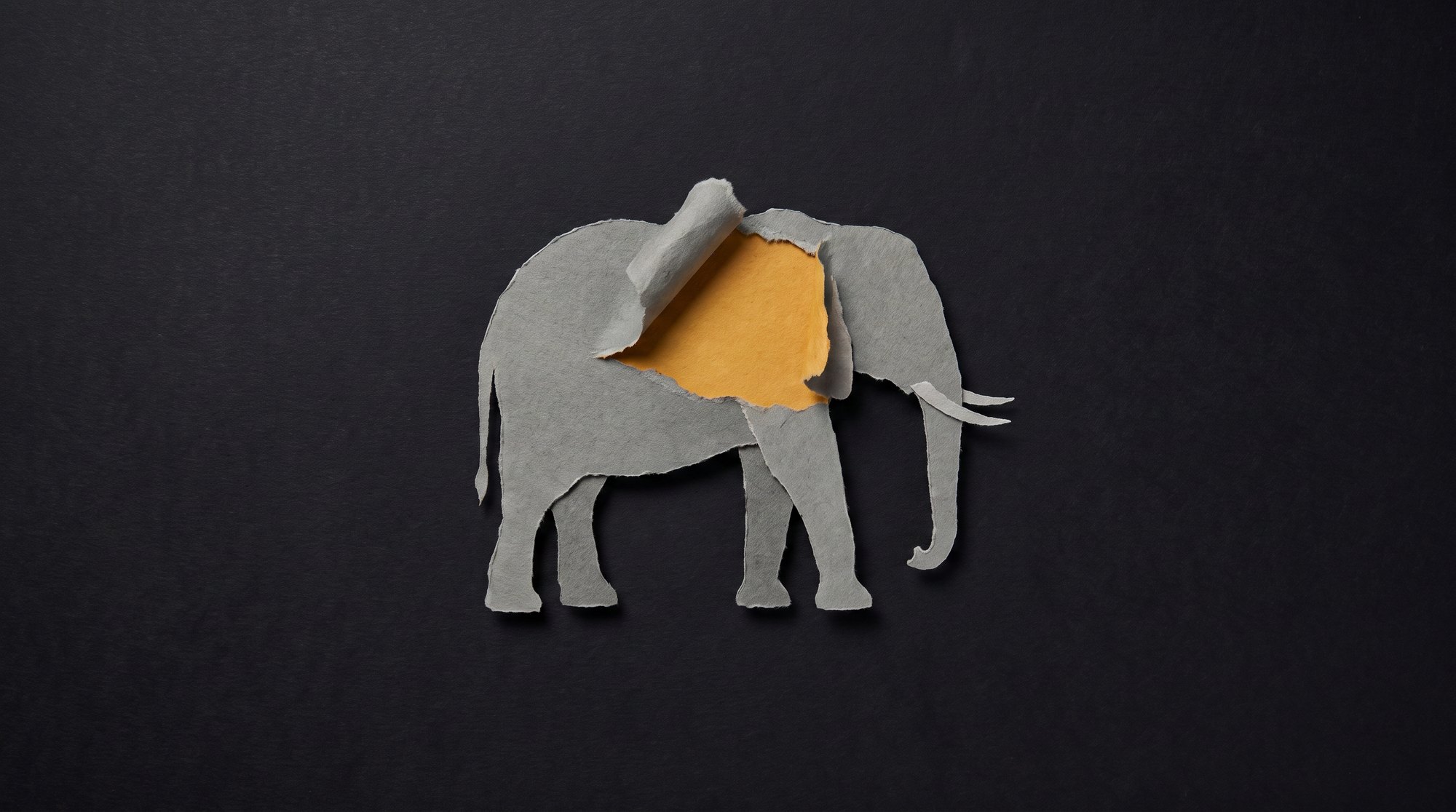
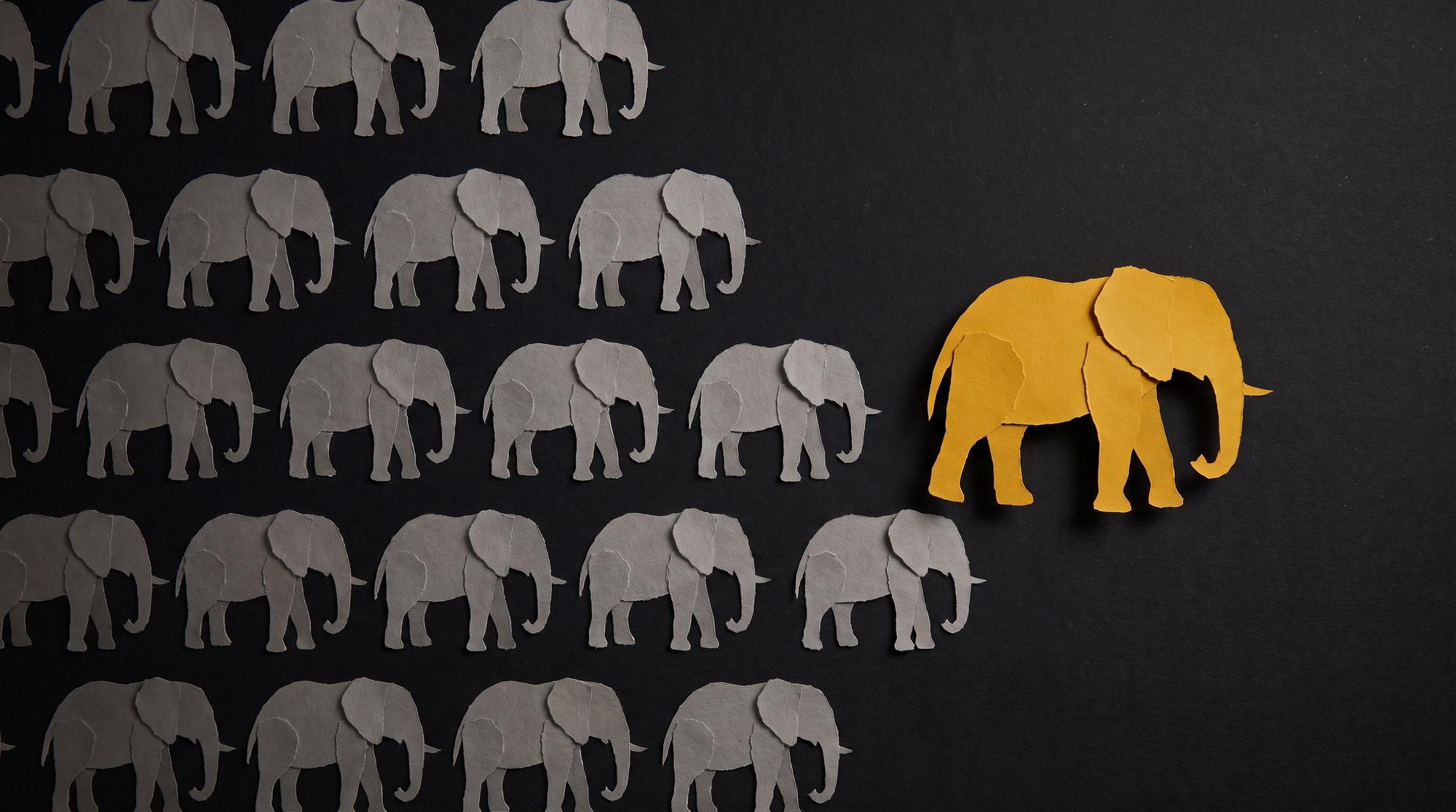
We think blending into our sector's codes is playing it safe. It's the opposite. Choosing caution is choosing the easy road, and the easy road leads to one place: the grey herd, where every elephant looks alike and nobody notices you any more. Looking like the others isn't protection. It's disappearance.
What holds people back, deep down, is fear. Fear of showing what sets them apart, in case it puts someone off. Except your difference isn't a flaw to hide. It's your best asset, often the only one that counts. What you do like everyone else is the standard, the bare minimum. What makes you choosable is the something extra.
Playing it safe is riskier than being different. Far riskier.
The worst part is that you don't disappear with a bang. You fade politely, one compromise at a time, until the day nobody could say what sets you apart. Not even you.
You already have your difference
Good news: there's nothing to invent. Being different isn't a pose you strike, it isn't "let's be different for the sake of it". Every organisation has its singularity, otherwise only one would be left. Yours already exists. The problem is you can't see it. And that's normal: nobody sees themselves from the outside.
And while you're looking, watch for the signals of a slide towards the grey. First: when you twist your message to match what you think is expected. Second: when you contort yourself to fit a template you find nice, but which has nothing to do with you. It should work the other way round, the tool adapts to you, never you to the tool. Third, the most telling: the day you hear yourself say "I know, my tagline is a bit bland". If you know it, you already know you've gone grey. You carry on only because you can't yet name your real difference.
You don't trumpet your singularity. You demonstrate it.
Here's the trap almost everyone falls into: believing that standing out means shouting about it. "Our strength is this." "What makes us unique is that." No. Singularity isn't trumpeted, it seeps out. It settles quietly, across a thousand details, in the form as much as the substance, and above all it's proven in the real world, not just in the communication. Boasting about your difference is dressing up. Saying you're extraordinary isn't your job, it's your clients' and your social proof's. Yours is to communicate in such a way that people feel it, without you having to say it.
An example. An organisation with a service aimed, literally, at everybody: children, working adults, the elderly. A genuinely human service, built on contact and proximity. So the first route, the logical one, was to show exactly that: lovely smiling faces and a "close to you, at every stage of life". We had even started organising the photo shoot with the real people behind the service, the ones who deliver it day to day. Nothing false about it, it was entirely accurate. The problem wasn't whether the message was true, it was how ordinary it sounded, the kind of line you meet everywhere and never stop in front of. So rather than asserting "we're human, we're warm" (what everyone claims), the bet went elsewhere: gamification. A character, a mascot with a real story, a companion that accompanies, reassures and guides, right through the website's journey. On paper, nothing guaranteed it would land.
And that's where it played out: that character speaks just as well to a six-year-old as to an elderly person. For the youngest it makes the experience playful. For those who didn't grow up with digital, it makes it less intimidating, a slightly funny guide explaining what to do, instead of a cold funnel where you feel stupid. One character, playful for some, reassuring for others, recognisable by all. And at no point did anyone need to write "we are warm and accessible". The character demonstrated it, at every interaction, for every generation. The result: a brand you recognise at a glance, and people asking for the next chapter of its story.
What can be felt never needs to be written.
Respect the codes without drowning in them
Standing out doesn't mean smashing everything. Some sectors have codes, sometimes essential to credibility, and ignoring them would be suicidal. But respecting the codes and asserting your singularity aren't incompatible, far from it. You differentiate inside the frame: "here are all the expected codes, and here's what we add". That small addition can even consist of pushing one code further than anyone else.
One thing worth knowing, though: codes are often more an impression than a reality. "In our line of work, that isn't done" is the oldest excuse there is, and often the epitaph of the brands we've forgotten. You hear it everywhere, and it has almost never been tested. If nobody ever tries anything, everyone stays frozen and the first to dare takes the pot. So test. A format, a stance, a sister brand to probe a neighbouring audience, without betting the whole house. You'll soon see whether the famous straitjacket was real, or just a fear dressed up as a rule.
The courage to displease
That's the real threshold, and it's mental. Owning your singularity means accepting you'll put some people off. It terrifies most business owners. And yet it's simple arithmetic: you don't speak the same way to someone buying a Rolex and to a discounter's customer, they're two worlds. When you stand in the middle so as not to ruffle anyone, you're no longer speaking to anyone. When you try to please everyone, you please no one.
Those your difference drives away? You'd have lost them anyway. Worse: trying to please them, you'd have lied to them, and harvested disappointment and bad reviews. So owning who you are is a filter, not a loss. It sends away the wrong ones and makes the right ones more convinced still. Because a clear identity reassures, while vague positioning worries. Clarity reassures, blur unsettles.
Two safeguards, all the same. Standing out doesn't mean running others down: you can perfectly well assert your difference and remain complementary to others in your sector, up to and including partnerships. And beware of fatigue: hammering "look how different I am" eventually wears people out. Singularity holds over time, across every touchpoint, with enough variety of formats and subjects not to become a refrain. Trumpeting it on the homepage while blending into the grey everywhere else isn't singularity. It's a costume.
Why it matters now
It has never been easier to produce content, and the ocean of grey has never been so vast. With one dizzying detail: AI now feeds on its own content. It copies the AI that copies the AI, a photocopy of a photocopy, and then we're surprised everything looks alike. The more it turns, the more the generic becomes generic.
Which leaves a wide open road for those who anchor their communication in the real world, precisely where no machine can go. In this saturated world, the rare material is no longer production quality, everyone has access to that. It's authenticity. So much so that a small owned imperfection, a rough edge, something slightly crooked, will say more about your humanity than the slickest campaign. And stop chasing vanity metrics: ten views that spark a real conversation are worth a thousand times a million views that lead nowhere.
So no, don't try to please everyone. Try to be irreplaceable to a few. It's less comfortable, it takes courage, and it will cost you people along the way. All the better: those people were never yours. The herd is vast, grey, and perfectly forgettable. You have a colour. It's time you showed it.